How do I get checked for lipedema?
There is no blood test or scan that confirms lipedema on its own. A clinician usually looks at your legs, asks about your history and rules out other causes. Coming prepared with a few weeks of notes makes that conversation much easier.

About Renya
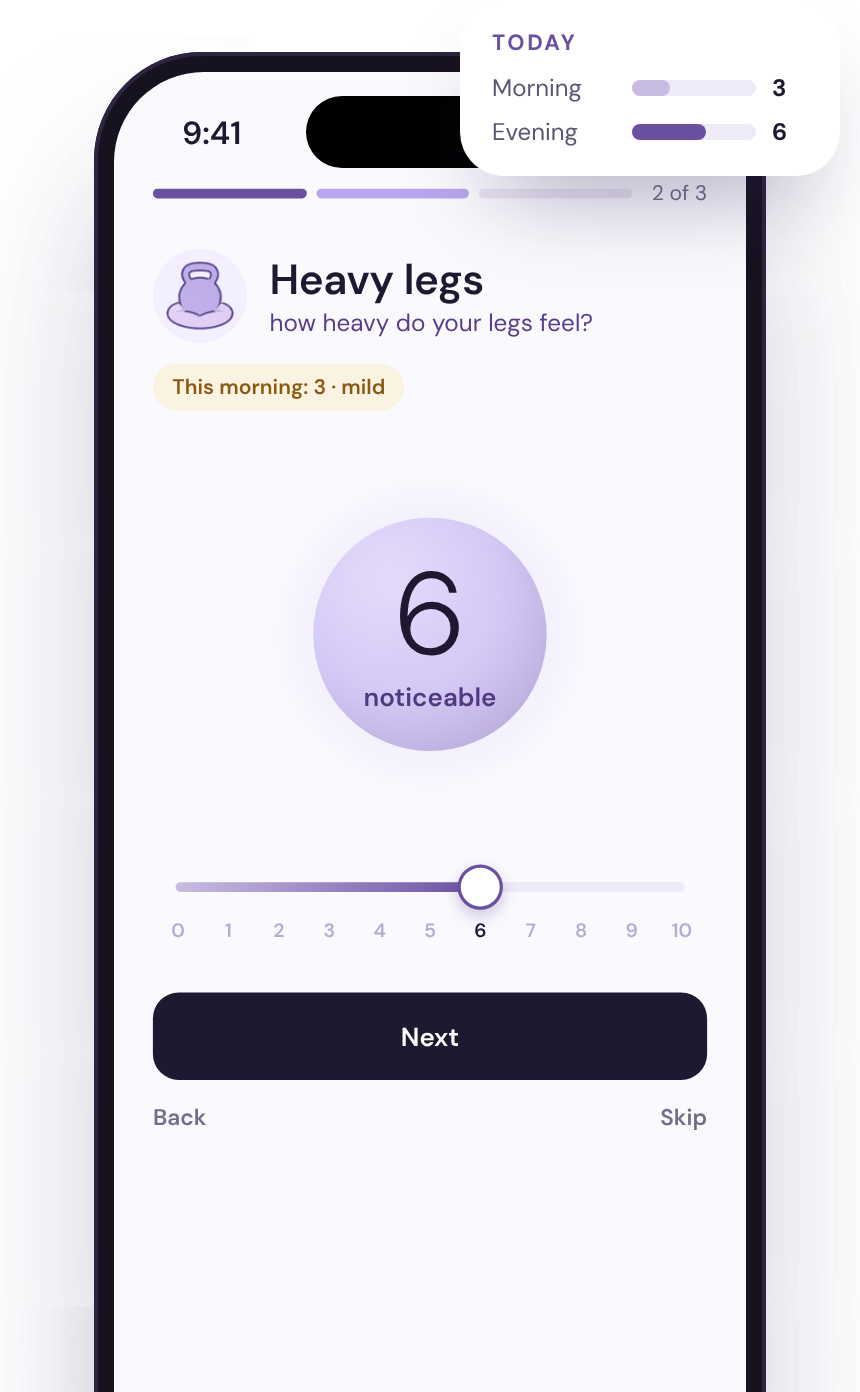
Renya is a daily diary for your legs: rate how they feel morning and evening, snap your meals and see what lines up.
Get the appCommon reasons
Start with your GP or family doctor
The NHS suggests seeing a GP if you have symptoms of lipedema. If they think it may be lipedema, they can refer you to a specialist.
Source: NHS: Lipoedema
Or look for a clinician who knows lipedema
Lipedema is still not well known, so many people look for clinicians who list it as something they diagnose or treat. The directories below are a good place to start.
Could it be lipedema?
Common signs listed by the NHS include both legs being affected in the same way, feet usually staying slim, skin that feels soft and cool or dimpled, bruising easily, and heaviness or tenderness that can get worse later in the day or in hot weather. You do not need to have every sign to ask about it.
See how many lipedema signs your legs share in the leg check →
Start a leg diary before your appointment
Doctors often ask when it started, when it is worse and what seems to make a difference. A few weeks of notes turn “it’s just bad sometimes” into something you can show. Worth writing down:
- How your legs feel, morning and evening, for 2–4 weeks
- Bruises and tender spots
- Swelling and when it goes down
- Family members with similar legs
- Questions you want to ask
How Renya helps
Renya is a daily diary for your legs. Rate how your legs feel morning and evening, snap your meals, tick off habits like a walk or compression socks, and add sleep, stress and your cycle.
After about a week of entries, Your patterns shows how food, sleep, activity and stress line up with your better and harder leg days; cycle patterns need about two cycles. You see your own patterns side by side, and you have a clear record to bring to your doctor. Renya does not diagnose anything.
iPhone subscription app. 7-day free trial on the annual plan.
Get help the same day if
- one leg is suddenly swollen, or has throbbing pain, usually in the calf or thigh
- the skin around the painful area is red, darkened or warm
- swelling is severe, painful, starts very suddenly or follows an injury
- you also have swelling in your face or tummy, or a high temperature
Call emergency services if leg pain or swelling comes with breathlessness or chest pain.
Based on NHS: DVT and NHS: oedema.
Questions people ask
Finding a doctor who knows lipedema
A GP or family doctor is a good first step. Lipedema is still not widely known, so many women also look for a clinician who lists it in their work. These organisations keep directories or support networks:
United States
Lipedema Foundation provider directoryClinicians and therapists who say they diagnose or treat lipedema.
United Kingdom
Lipoedema UKInformation and support. The NHS suggests starting with your GP, who can refer you.
United Kingdom
Lymphoedema Training Academy therapist directorySearch your area and filter for lipoedema therapists.
Ireland
Lipoedema Support Network IrelandPatient-led support and practical guidance for women in Ireland.
Australia
Lipoedema Australia practitioner directoryPractitioners across Australia.
Australia & New Zealand
Australasian Lymphology Association registerAccredited lymphoedema practitioners, many of whom also see lipoedema.
Renya is not connected to these organisations and does not recommend individual clinicians.
Related
Sources
- NHS: Lipoedema
- Lipedema Foundation: Provider directory
- Lipoedema UK: What is lipoedema?
- healthdirect Australia: Lipoedema
Written by the Renya team from NHS and other public sources listed above.
This page is general information, not medical advice or a diagnosis. Renya is a wellness diary and does not diagnose or treat any condition. If you are worried about your legs, talk to a doctor.
See your own leg patterns
Check in on your legs, snap your meals and see what lines up with your harder days. iPhone subscription app. Android coming soon.